
Waiting for bottlenose dolphins to surface in the Caribbean Sea at Si'an Ka'an Biosphere Reserve,
Quintana Roo, Mexico
For over a decade, I have pleaded with my wife to devote some of our vacation time to the Riviera Maya, the 60-mile stretch of beaches south of Cancun. We almost went several times, but every time we tried to book an eco-friendly hotel, it seemed like it had gone out of business, or had retreated to a new location further and further south of the burgeoning development spreading from Cancun, so we never committed. My wife is a university administrator and only has certain windows of time when she can get away when the university is not in session, and the time between the holidays and the Martin Luther King holiday is one of those times. She always complains that she has time off that she can't take, and that she hates winter, but we never do anything about it. So, this year, I took the bull by the horns and marched her into a travel agency between Christmas and New Years, and we booked a 6-day, 5-night trip to the Riviera Maya. Because it was so late (we planned to go before January 18), we didn't have much time to do research on accommodations, so we relied on the travel agent (and some quick reviews of Mexico travel guides), and chose an all-inclusive resort just outside the city of Playa del Carmen, about 30 miles south of Cancun. We're not "all inclusive" type people, and this was our first exposure to such a resort (sort of a mega-cruise ship concept on land), but I don't regret the decision.We had a great time.It could have been warmer (upper 60s and low 70s; typically, it's about 80 this time of year), and it could have been sunnier (partly or mostly cloudy nearly every day, with one full day of rain), but compared to the deep freeze gripping the eastern half of the United States while we were there, it was paradise.We took two excursions, one to Si'an Ka'an, a national park/UNESCO biosphere reserve at the far south end of Riviera Maya, just north of Belize, and a second to Chichen Itza, the excavated Mayan city in Yucatan state.Before we left the United States, I frantically tried to find a birding guide to Mexico. There isn't a single good field guide. The guides that are available are (1) too large to carry into the field, (2) too poorly illustrated, or (3) limited only to the birds indigenous to Mexico, excluding those also present in North America and migrants from North America wintering in Mexico. So, I express-purchased from Amazon the Peterson guide to Mexican Birds, and carried along my copy of All the Birds of North America. It was mostly all for naught, anyway; we saw very few birds--except for the utterly ubiquitous Great-tailed Grackles (Quiscalus mexicanus), which were everywhere.  Alex, our guide to the Si'an Ka'an Biosphere Reserve, scouting for dolphins and sea turtles. Alex is a transplanted Italian from Rome who fell in love with the Yucatan.
Si'an Ka'an (the Mayan name for the area which means roughly "where the sky was born" or "contemplate the heavens") is a mangrove swamp-upland dry forest-coastal strand complex. We took a boat from the fishing village in the preserve, Punto Allen, in search of common bottlenose dolphins (Tursiops truncatus), sea turtles (loggerhead [Caretta caretta] and hawksbill [Eretmychelys imbricta]), and a Magnificent Frigatebird (Fregata manificens) rookery, all of which we saw. We also got to snorkel in the reef off Punto Allen, and to loll in a 4-foot-deep natural sandy Caribbean "swimming hole."
 A group of six Italian tourists who accompanied us on our tour of the Si'an Ka'an Biosphere Reserve. We're all waiting for a sea turtle (visible just under the surface) to come up for air--which it promptly did just after I made this image.
Visiting Chichen Itza was something I had always wanted to do, but never thought I'd actually accomplish. It's probably in that book of 1000 Places to See Before You Die. It's really a remarkable place and, even though we were there for three hours and it was not particularly crowded, I could have spent at least several more hours there. I felt like we just scratched the surface of what's available. One aspect of the visit was a little disconcerting: there are hundreds of native craft vendors everywhere--outside the gate, inside the gate, and lined up along every inch of the periphery of the site. All are hawking their wares, and all have about the same kinds of items, most (but not all) of which are junk.
 Yours truly at the great pyramid at the Mayan city of Chichen Itza.
  Our daylong tour to Chicken Itza concluded with a stop at a cenote (water-filled sinkhole) for a swim. The Yucatan peninsula is underlain by limestone, which dissolves readily and collapses into sinkholes connected with underground rivers.
The beach at our resort, the Iberostar Tucan. In the center background, at the edge of the water, a huge, dark fabric bag filled with sand is visible. These erosion control devices, which we nicknamed "beach whales," were deployed all along the beach to try to retain the sand.
 The beach at sunset on a rough day. The hotels on the island of Cozumel, 12 miles off the coast, were glowing in late day sunlight in the center of the image.
 Tropical image: The tile grillwork on the stairwell landing between floors at our hotel.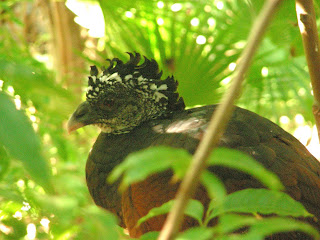
The developers left a small area of native habitat on the grounds of the hotel, then introduced some of the region's animals. This is a Great Curassow (Crax rubra), which lives in the Yucatan. I'd never be able to get an image like this if I were out in the forest.
 Resident free-ranging wildlife takes advantage of the hotel grounds, too--even the developed portions; capybaras (Hydrochoerus hydrochaeris) roamed the hotel lobby, and howler monkeys (Alouatta palliata mexicana)made homes in the trees outside out hotel room. The hotel complex includes numerous interconnected ponds and watercourses containing huge goldfish--and many "minnows." This Great Egret (Ardea alba) (and several Snowy Egrets [Egretta thula]) knew a good thing when they found it. Breakfast is served (to humans in the dining room in the rear, and to the waders in the front).

 Early one morning last week, I came out of the house to get the morning newspaper and immediately smelled a skunk. Skunks are often roadkill victims or prey for Great Horned Owls in my neighborhood, so I didn't give the odor much thought. On my way to the curb, I saw the source of the odor, lying dead alongside the driveway and--just out of the corner of my eye--a Great Horned Owl swooping off into the woods next door.


