Friday, January 21, 2011

New Mexico: Sandhill Cranes and Snow Geese at Bosque del Apache

In 2003, I visited Austin, Texas, for a conference. On my first night in town, I walked downtown just before dusk and gathered with hundreds of other people at a park below the Congress Street Bridge over the Colorado River and waited.  As the light waned and darkness increased, first a few, and then a thousands of Mexican Free-tailed Bats emerged from their diurnal roosts under the bridge to head out into the surrounding farms and ranches to feed.  There were so many bats that they looked like dense smoke billowing skyward.  I have to admit that I was overcome with emotion at this natural spectacle - tears welled in my eyes and my throat choked up.  I'm glad that it was dark so that no one could see macho man reduced to blubbering.

Though it didn't get that far in New Mexico, seeing countless thousands of Snow Geese suddenly explode from the surface of a marsh, wheel around in the air for a minute or so, and then settle back onto the pond nearly invoked the same reaction.

Our third natural history stop in New Mexico was Bosque del Apache National Wildlife Refuge just south of Socorro.  One of the main reasons we planned to visit southern New Mexico in January was to stop at Bosque del Apache, where thousands of Sandhill Cranes (Grus canadensis) and Snow Geese (Chen caerulescens) overwinter.
We were not disappointed.  We first spotted cranes in three "outlier" ponds as we drove along the access road (NM Rte. 1)to the refuge, and then saw thousands more foraging in the corn fields that are planted for the cranes and the Snow Geese within the the refuge proper.
We spent a full, glorious sunny and warm day at the refuge - our warmest in New Mexico.  We tallied about 25 species of birds (plus two handsome coyotes and three mule deer) on our 12-mile drive around the marshes and farm fields in the refuge - far fewer than we had seen on our March visit a few years ago, but a respectable number for the winter according to one of the refuge naturalists.  None of the birds we spotted was new for us, but we really came for the astounding numbers of cranes gathered there.
Bald Eagle on a snag
One of three Bald Eagles Eagles we observed.  Image captured with the optical zoom of my point-and-shoot Nikon.
As sundown approached, we positioned ourselves along NM 1 once again for one of the refuge's daily winter highlights: the "fly in."  As the sun goes down, cranes and geese fly back to the safety of the refuge's marshes and ponds for the evening from their day's foraging in the surrounding landscape. Hundreds and hundreds of birds approach in squadrons and land in the wetlands.  (The reverse half of the spectacle, the "fly out" at dawn, has not been impressive this year according to refuge volunteers because the traditional gathering wetland has been frozen over and, instead of congregating in one gigantic flock that takes off at sunrise a la Austin's bats, the cranes and geese have divided themselves into smaller groups at ponds scattered throughout the refuge where the water remains open.
We returned to the refuge two days later before we headed back to the airport for a final look at the cranes and to try to spot an Aplomado Falcon that had been seen frequenting a grove of cottonwoods, but the day was very cold and windy, the ponds where we had seen the cranes two days earlier were frozen, and there was no sign of the falcon. 
A Great Blue Heron for Grizz

Tuesday, January 18, 2011

New Mexico: Hike to Dripping Springs, Organ Mountains

Approach to Dripping Springs Canyon
On the afternoon of our last day in Las Cruces, we took the one-mile walk to Dripping Springs on the western flank of the lava-derived (southern) portion of the Organ Mountains (see previous post for more about the geology of the region).

The Chihuahuan desert is very dry, and these dependable springs have been known for centuries.  Just down slope of the actual springs, archeologists excavated the floor of a rock shelter (La Cueva, The Cave) that contained evidence that the canyon containing the springs has been occupied by people for millennia.

Between the end of the 19th century and the 1930's, the Dripping Springs canyon was the site of mountain resorts and a sanatorium.  When the first, wood-framed resort failed, it was turned into a tuberculosis sanatorium.  Eventually, that site was abandoned, but a new, larger resort with stone buildings was built further up the canyon.  The remains of the wood-framed and stone buildings are scattered throughout, as are two silted-up reservoirs that were built to contain and store the water from the springs.

A coup used to house chickens for the resort

Remains of the sanatorium
The stone hotel at the mountain camp
When we visited, the spring flow was unimpressive - either the springs are very modest affairs, or they flow more generously in other times of the year.  In fact, it was difficult to see the water dripping out of the canyon above.  Nevertheless, it obviously provided enough water to operate the resorts successfully.
The Dripping Springs (bottom center)
The canyon and the springs were saved by The Nature Conservancy (TNC), which bought the property and then sold it to the Bureau of Land Management for a protected natural area.  Because of the presence of the water, the canyon supports rare and endangered plants, prompting TNC's interest.  The hike up to the springs from the visitor center was a relatively easy one-mile uphill trek on a gravel road that had previously been used to service the resorts.
View westward toward Las Cruces and the Rio Grande valley

Monday, January 17, 2011

New Mexico: Hike to Baylor Pass, Organ Mountains


Our fifth trip to New Mexico.  If everything works out (a big "if," of course), we'll almost certainly retire there.  The question is: where?  This trip to the south-central part of the fourth largest state in the union confirmed our love for wide open spaces and the Chihuahuan desert.  We can think of far worse places to land than Las Cruces, for example, the second-largest metropolis in the state.

Our first hike during this New Mexican trip took us to the Baylor Pass Trail in the Organ Mountains about 20 miles east of Las Cruces.  As a mountain range, the Organs are relatively small.  They don't even show up on my Rand McNally road atlas of New Mexico.  Nevertheless, they are dramatic because they are so craggy.  Though I beg to differ, I read several comparisons to Wyoming's Grand Tetons in Las Cruces Chamber of Commerce promotional material.
Chihuahuan desert vegetation along the trail
The mountain range has two origins.  The northern half - the dramatic, craggy half - is the eroded remnant of a batholith.  Magma pooled under the earth's surface but never broke through, cooling and solidifying underground.  The southern end of the mountains is the remnant of magma that did breach the earth's surface in a typical volcanic eruption.  The suture between the two is plain and stark:  the northern batholith is light pink-gray granite, while the southern is dark brown lava.
View southward along the eastern flank of the lava-derived portion of the Organ Mountains
The Organs are also one of the numerous "sky islands" that dot the southwest all along the Mexican border.  Unlike oceanic islands surrounded by water, the sky island mountain ranges are separated from one another by desert "seas," making them hotbeds for speciation and endemism.
Snow along the trail from a storm one week earlier.  The divided peaks are called the Rabbit Ears.
We chose to walk the Baylor Pass National Recreation Trail.  The 6-mile trail traverses the mountains, crossing at Baylor Pass.  The approach from the east reaches the pass in 2 miles, while the approach from the west requires a 4-mile hike to reach the pass.  We selected the shorter hike, climbing about 900 feet from the trailhead to the pass and then returning on the same route.  With leisurely breaks for birdwatching, photography, and lunch, the trek took us about four hours.   Temperatures were in low 50s - perfect for hiking, especially when the sun is out.  I even got a bit of a sunburn!
View eastward from Baylor Pass over the Tularosa Basin

Along the trail

Friday, January 14, 2011

Ice Rings

 Kali and I just returned from a week in southern New Mexico, so I'll post about our exploration of the Chihuahuan desert natural world over the next few days.

In the meantime, some images of ice rings that formed in a pool alongside my creek.  These images were taken by a colleague from New York City when she and I went for a walk in my natural area on December 14--before we were buried by two snowstorms.

Tuesday, December 28, 2010

Boxing Day Snowstorm

The back yard at first light
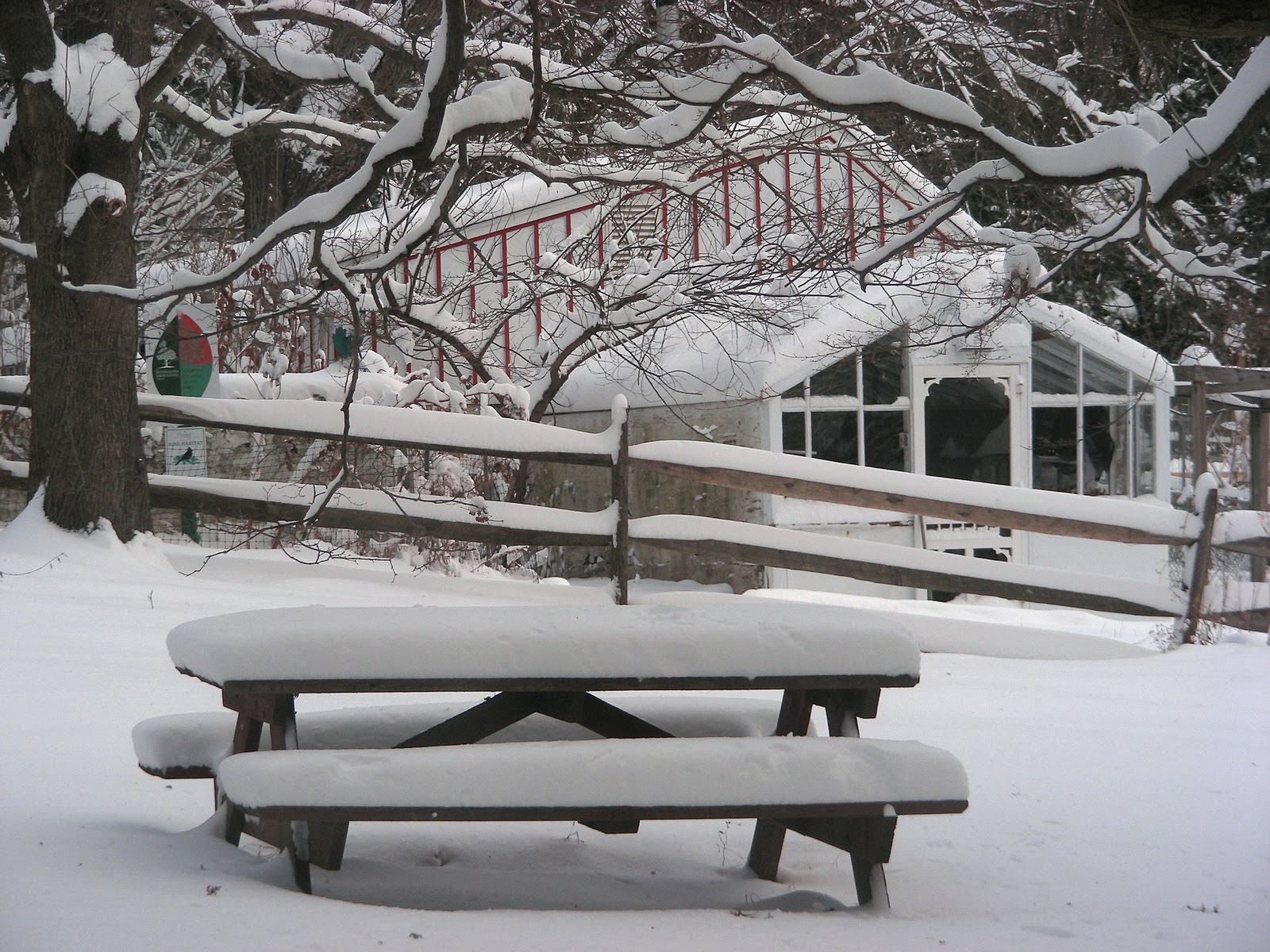
It started soon after Kali and I returned from bargain-hunting on the morning after Christmas and didn't let up until the wee hours of Monday morning.  When it was all over, we had a foot of snow--our portion of the Boxing Day East Coast 2010 snowstorm.  It was enough to keep me from going to work yesterday for business as usual, but I still had to spend several hours shoveling to make the place ready for opening today.

Sunrise through broken clouds


Sunrise across the frozen, snow-covered pond
 
The sycamore behind the house after the storm cleared

Christmas Eve Visits


Harper's Run
Our friends Jean and Joel, two Philadelphia-suburb expats now exiled to St. Paul, Minnesota, came to visit on Christmas Eve, as they do nearly every year. They still have lots of friends and family in southeastern Pennsylvania, so it's not just us they're in town to see.  Nevertheless, if the weather's nice and the trail conditions appropriate, we try to take long walk with them and to catch up on a year's news.

We decided to walk in the county park where a two-mile rails-to-trails project had been completed 1-1/2 years ago.  A portion of the trail runs alongside Harper's Run, one of my favorite photographic subjects.  Because of the persistent cold weather, rocky parts of the shallow stream had iced-up.


After we bid our friends adieu in mid-afternoon, we returned to the house, where I spent the rest of the daylight hours grading final exams from the graduate course I had just finished teaching.  Those exams, while generally good, certainly did not put me in a Christmas mood (which was already at low ebb, anyway, thank you very much Mr. Grinch).  However, as the sun set, we got ourselves ready to attend the annual Christmas Eve gala organized by one of our neighbors--a couple so preternaturally gregarious, generous, and welcoming and that you'd almost claim they'd been raised in Stepford.  Great food in prodigious quantities, a beautifully decorated house jammed with interesting people, and 56 varieties of red wine.  I challenge you not to have a good time!

Tuesday, December 7, 2010

Parsons Dance / Remember Me

David Parson's dance company, Parsons Dance, was in town for four performances last weekend.  The program consisted of two works.  The first was one of Parsons's signature dances, Caught, which never fails to elicit a gasp out of newcomers and heartfelt admiration from those of us who have seen the work performed several times.  The dance, a solo, involves a dancer moving around a blackened stage fleetingly illuminated by stobe lights so that the dancer appears to be flying.  It's magic.

Unfortunately, the same can't be said of the second piece, Remember Me.  Critics have savaged this piece, but audiences generally love it.  I went into the performance with an open mind, ready to prove the snobby New York dance establishment wrong.  Unfortunately, the critics did get it right (in the opinion of Kali, several other aficionados, and me who talked after the performance).

Remember Me is a collaboration between Parsons Dance and the East Village Opera Company, which supplied two singers for the endeavor.  The work consists of a simple romantic love triangle played out to the tune of thirteen of the most famous operatic arias performed live on stage.  But, did the producers use the arias as written?  Oh, no; instead, they pumped them up with near-ear splitting rock guitar background music.  Then Parsons's dancers performed the story, which was insultingly shallow and maudlin.  Woman wooded by two men rebuffs Man A, who then proceeds to rape her.  When Man B finds out about the woman's soiled past he, in turn, rebuffs her, and she proceeds to die of a broken heart.  Then, she is resurrected and lives happily ever after with Man B.  Maybe this kind of thing would have worked in the Middle Ages or at the hands of a master like Shakespeare, but contemporary audiences are just a little bit too cynical to buy this.  Or, maybe not, since it's a popular hit.  DVDs of the performance were completely sold out, and a quick trip to NYC to restock resulted in another sellout.

The dancers certainly couldn't be faulted.  They were expert and performed flawlessly and tirelessly, as they always do. Parson Dance is among the best companies on the contemporary dance scene.  That's why a piece like Remember Me was so disappointing.