Thursday, November 22, 2012

One Trail Twelve Times - November


Asian bittersweet's (Celastrus orbiculatus) irresistible yellow carpels and red fruits tempt wreath makers, who then discard their handiwork after the holidays, thus helping to spread this menace.
Five walkers joined me for the penultimate installment of One Trail Twelve Times on Sunday afternoon, November 18, under partly sunny skies with temperatures in the upper 50s.  At first, I thought that we might complete the circuit of the Beech Springs Trail in record time because the somber, dun-colored fields seemed to offer little to observe.  But, in the end, we actually returned a bit later than usual; there's always plenty to enjoy.

When we entered the woods and immediately came upon a red oak (Quercus rubra) brought down across the trail by Hurricane Sandy.  Though the staff had cleared the canopy of the oak out of the path, the limbs, branches and trunk remained.


The downed red oak trunk sprawled across the forest floor
Red oak - dismembered
At the woods-meadow edge, the white pine saplings were damaged by bucks rubbing their stems and eating their tender tops.  Must give them piney fresh breath!
Emerging from the woods into the upper fields.  The buildings in the distance are a barn complex built in the 1920s when the fields were used for grazing cattle.  Today, the buildings have been renovated for use as the maintenance and office complex of a church.
Goldenrod (Solidago spp.) in seed
Indian-hemp (Apocynum cannabinum) seeds
Horse-nettle (Solanum carolinense), a weedy, prickly native member of the tomato family

When we left the wet meadows, crossing the Eagle Scout footbridge across the gully, I looked downstream.  Normally, the sight line is limited by a tangle of nearly impenetrable vegetation, but with the onset of autumn many of the plants had lost their leaves, revealing a pool and high, rocky banks adorned with Christmas ferns (Polystichum acrostichoides).

American Hornbeam (or Musclewood, or Blue-beech, or Ironwood) (Carpinus carolinense)  helping to stabilize the gully's bank.
A fallen tree spanning one of the Beech Spring runs.  I've included an image of this tree in each post as a marker and reference for the walk.  The spring run was completely dry on the surface; we've had almost no rain since Hurricane Sandy, and even Sandy's contribution was modest.
November in the beech woods

With the leaves gone from the native spicebush (Lindera benzoin) shrub layer, it has become obvious that the shrub layer is not all spicebush but also includes a healthy population of invasive, non-native jetbead (Rhodotypos scandense )that, like many non-native plants, holds its leaves longer than the natives.  Such a strategy gives the invasives a competitive advantage over the natives because they can photosynthesize longer than the natives. 


As the group rounded a corner in the trail, we came across a large white oak (Quercus alba) uprooted by Hurricane Sandy.  If you look closely at the left side of the image, you'll see that that the oak toppled into a neighboring tree, uprooting that tree as well like two tumbling dominoes.
A hard, dessicated, mahogany-colored fungus at the base of an oak tree
Termite-riddled base of the Pileated Woodpecker Tree
Around the next bend in the trail, we came upon another sad casualty of Hurricane Sandy--the Pileated Woodpecker Tree. This bird cherry (Prunus avium) snag bore an unmistakable rectangular  hole excavated by a Pileated Woodpecker and was a landmark along the walk.  Bird cherry wood is not strong in the first place, and the insect damage at its base had clearly weakened the tree enough to topple it during the hurricane.  The fallen trunk had blocked the trail, so my staff had cut it into manageable sections to clear the path.

Pileated Woodpecker Tree
On close inspection, we discovered that fungi had colonized the tree, and had begun to emerge through cracks in the bark - like fiery lava oozing out of the earth!
Blackberry (Rubus sp.) in regal purple
Kali helping to disperse milkweed seeds.  This is among her favorite autumn activities, and helps to perpetuate milkweeds - and Monarchs!
Silvery samaras of a box-elder (Acer negundo) at the head of the gully
Botanizing at the edge of the meadow

The final leg of the trail passes along the center of a long double allee of white pines (Pinus strobus) planted in the 1920s.  Two of these pines lost major limbs during Hurricane Sandy, both of which came down across telephone and cable lines.  The telecommunication lines never snapped, but the limbs bowed them down to the ground.  These were among the last tree (parts) cleared off utility lines in our area because, unlike electricity, they were not essential and because the serve had not been interrupted.

One of the damaged white pines
Final vista across the late autumn fields
Because the end of this series of rambles is imminent, the "regulars" began to hector me about choosing another trail for the next year and repeating this program.  I'm reluctant to commit to one weekend afternoon a month again (though, in all honesty, it hasn't been onerous or interfered much with my life, and I've really enjoyed the walks and camaraderie).  I've discussed this with Kali, but haven't made a decision yet.  I'm thinking of doing one walk a month on a different trail each month until we complete a walk on every trail in the preserve.

Friday, November 9, 2012

One Trail Twelve Times - Belated October


Upper meadow on the Beech Springs Trail
Five walkers accompanied me for the October installment of my One Trail Twelve Times series of trail explorations on Sunday afternoon, October 21.  October is the second-busiest month around the preserve with many public activities scheduled, so I'm only now getting around to preparing a post.  Good thing, since the November walk is only 1-1/2 weeks away!


As we have been doing for most of the walks, we began our hike in a small stand of mature oak-beech forest.  I expected to find spicebushes (Lindera benzoin) laden with bright red drupes, but migrating birds had already harvested all of the fruits, and the leaves were turning a golden color.

Colorful foliage at the meadow's edge
A pair of Red-tailed Hawks (Buteo jamaicensis) successfully fledged chicks this year in the larger woods along the trail.  We've seen - or heard - one or both parents during almost every one of our monthly excursions.


A young tuliptree in gold regalia
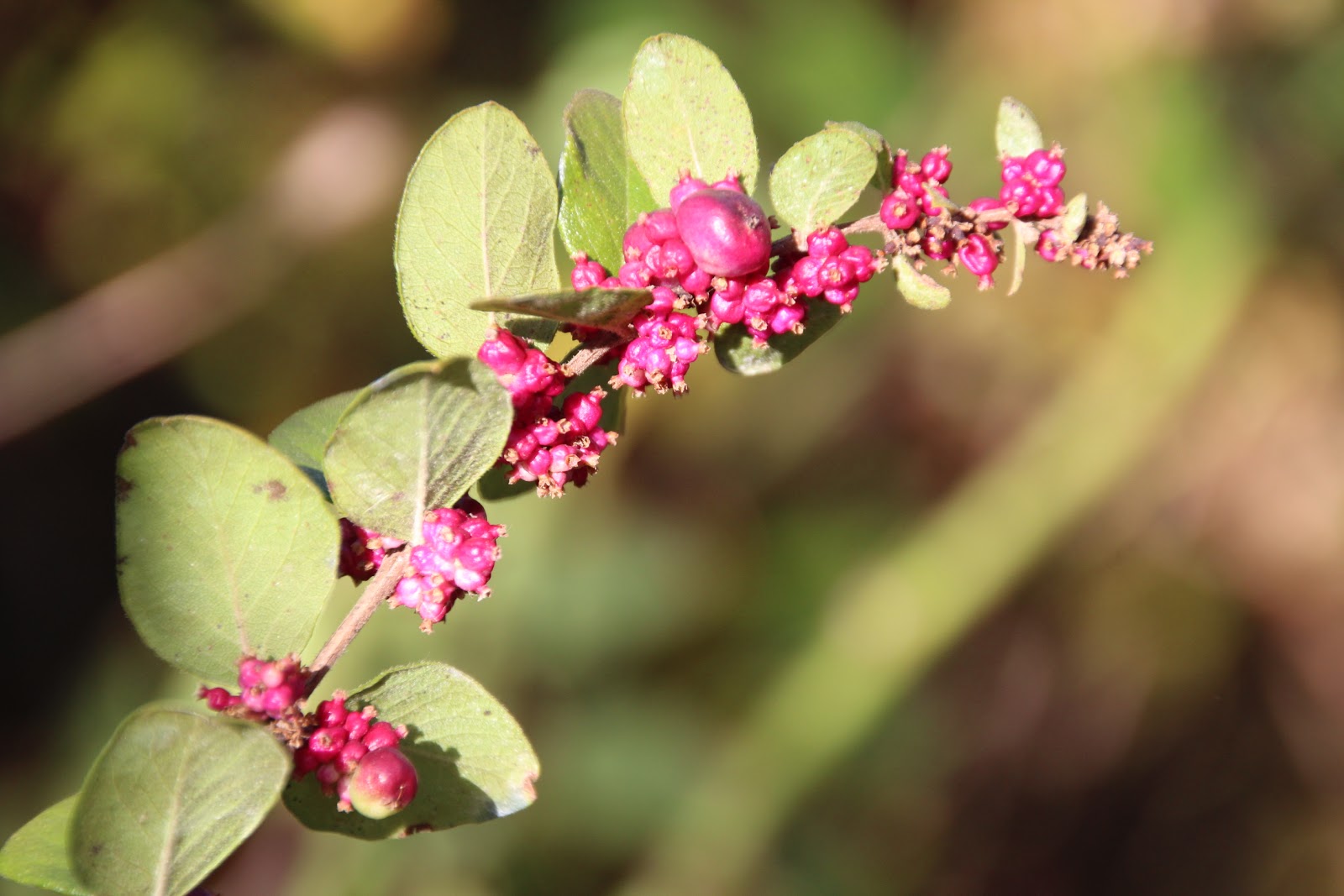
As we were walking the trail through the meadow, bright fuschia-colored berries alongside the path attracted our attention.  The plant completely confounded our collective identification skills in the field, but one of my staff members, trained as a horticulturist, identified the plant the next day as the aptly named coralberry or Indian-currant (Symphoricarpos orbiculatus), a native shrub.  The plant is not common in the preserve - I run across it only once every few years, and usually when it doesn't bear fruits - so I can never recall its identity.

Coralberry
A newly-formed goldenrod gall, winter home of a peacock fly larva (Eurosta solidaginis)
As we neared the low, wet end of the meadow, we heard a racket of bird calls emanating from a tree alongside a stream.  There, we found a large flock of American robins (Turdus migratorius) gorging themselves on tiny crabapples (Malus spp.).

Crabapples yellow...
...and red
Fragrant dried flower heads of mountain-mint (Pycnanthemum spp.)
New England Aster (Aster novea-angliae) still in full bloom late in the season
We left the meadow, crossed the handsome wooden footbridge built by Eagle Scouts last summer,  and entered the larger stand of forest along the trail.

October's explorers on the Boy Scout Bridge
The spring runs held no water - at least not above ground
A Skunk Cabbage sprout (Symplocarpus foetidus) in the bed of one of the spring runs
Sphagnum moss in a "nest" of fallen leaves
Silvery-green crustose lichens on a fallen limb
The mid-October forest
American beech (Fagus grandifolia)
The deer rut had already begun. We only saw one buck-rubbed cherry along the Beech Springs Trail, but elsewhere in the preserve the deer have been severely damaging appropriate-sized saplings.  They definitely seek out sumacs (Rhus spp.), which aren't common in the first place, and rub them so thoroughly that they girdle the stems.  Fortunately, sumacs root-sprout readily and the copses grow larger each year.

Buck-rubbed cherry stem
Out of the forest and back into the meadows
The common milkweed plants (Asclepias syriaca) in the field had all lost their leaves, and their seed pods were bursting open, but I noticed that nearly every one of the pods bore a bright orange milkweed bug (Oncopeltus fasciatus) nymph.  The adults of milkweed bugs can overwinter and renew the population when spring arrives, but I doubt that the soft-bodied nymphs will make it through the cold.

Milkweed bug nymph
Black Knapweed (or Hardhead) flower (Centaurea nigra)
A late season aster (Aster spp.)
The last segment of the trail travels between a twin allee of mature white pine trees (Pinus strobus) planted in the 1920s.  We're gradually losing these trees during storms - mostly when their tops snap off or the wind shears off a major limb, allowing fungi to enter the tree and begin a slow death spiral.  We lost two of the pines during Hurricane Sandy; they snapped off and their huge crowns brought down the fiber optic and telephone lines strung along the street.  While the allee is impressive, we won't replant these trees as they disappear; they are brittle, dangerous trees at the southern edge of their range.


Poison Ivy (Toxicodendron radicans) gracing a white pine trunk
A last look over the the autumn meadows
As I looked out over the fields and woods along the Beech Springs Trail today, it was hard to believe that the area was so colorful and vibrant just three weeks ago.  With the passage of Hurricane Sandy, we abruptly entered winter.  Most of the leaves are gone, and those that remain are brown.  In a fortnight, the natural world transformed from glorious high autumn to nearly desolate winter.


Wednesday, November 7, 2012

Noticed Along the Way

Woollybear
While Kali and I were walking throughout "my" natural area preserve last Sunday photo-documenting the damage to the forest caused by Hurricane Sandy (see "In the Wake of Hurricane Sandy" post), I noticed a few other interesting and/or photogenic mid-autumn subjects.

For example, the trails were "littered" with woollybear caterpillars (Isia isabella).  I don't think I've ever noticed them in such densities before.  They're all searching for a protected spot in which to overwinter safely as pupae so as to emerge in the spring as rather drab and nondescript tiger moths.

Watch-hazel in bloom
On the edge of a woodland with a relatively warm southern exposure, we came across a large, golden witch-hazel shrub (Hamamelis virginiana) in bloom.  Witch-hazels are the latest-blooming flowering plant in the Mid-Atlantic.


As I was capturing the image of woody debris produced when my staff and I cut up a 125-year-old oak tree brought down by the hurricane, I found this polypore bracket fungus on a nearby well-seasoned log that my staff had cut years ago.

And, finally, in a herbaceous old-field, I came across this purple and green plant.  I have no idea as to its identity - it's probably a non-native "weed" - but its striking coloration attracted my attention

_____

The forecast calls for a nor'easter storm tonight and tomorrow morning, with high winds and the possibility of snow; it's been snowing lightly since mid-morning today (Wednesday) and we may get two to four inches.  I certainly hope we don't get any accumulation or high winds; we don't need the electric power to be interrupted again so soon after the outage associated with Hurricane Sandy.  If we get get any significant snow accumulation, it will be only the fourth time since weather records have been kept (dating from the 1880s) that there will be measurable snow in our area during the first week of November.  What's next--a plague of locusts?