Showing posts with label disturbed forest. Show all posts

Thursday, April 3, 2014

Haddington Woods


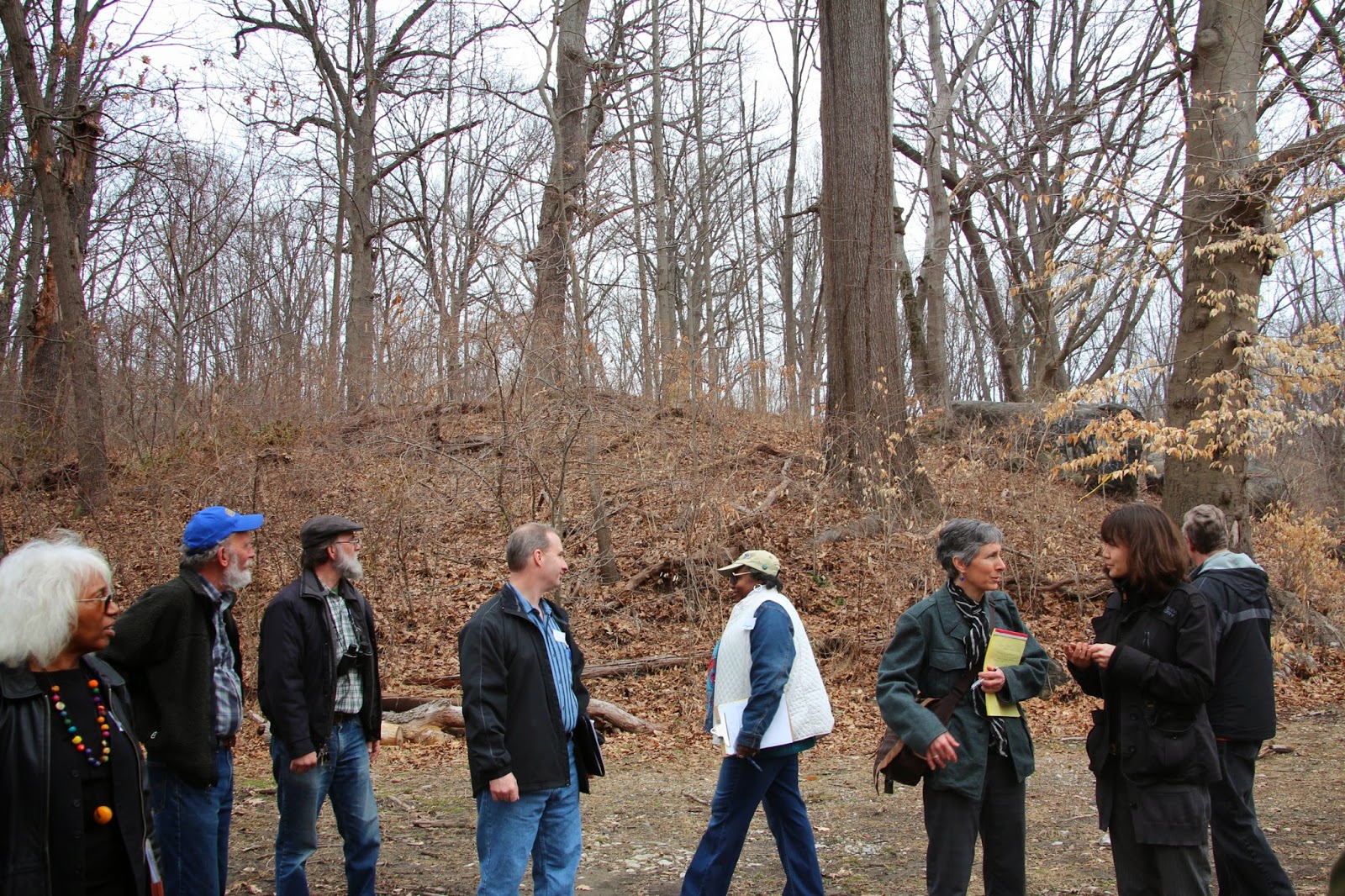
Colleagues at the edge of the old growth
The Philadelphia Department of Parks and Recreation (P&R) has invited me to participate in its Urban Forest Working Group, a rather august group of professionals from southeastern Pennsylvania, all of whose members are involved in some aspect of forest restoration.  Philadelphia P&R has mobilized the group to solicit feedback and guidance on forest restoration projects in the city's parks.  I missed group's first meeting (on February 5) because that was the day our infamous regional ice storm shut down most of the area (some participants, somehow, managed to get to the meeting).  Because I missed the first meeting, I was anxious to attend the second, scheduled yesterday (April 2).  In addition, this second meeting included a field trip to an ancient forest - Haddington Woods - probably the finest old growth forest in the city.
Schist boulders weathered out of the hillside; some bear graffiti - hey, it's the city
Not all of Haddington Woods is high quality old growth; in fact, only 5 acres of the 27 acre forest are ancient woods.  Other parts of the site are very badly degraded by invasive vines, which blanket the trees with their weighty green shrouds.  Though we enjoyed visiting the old forest, we spent most of our time in the field surveying the areas of the park most in need of restoration.
Weighing options for restoration
Haddington Woods is a small part of the city's 851-acre Cobb's Creek Park located on the extreme western edge of Philadelphia.  In fact, Cobb's Creek traces the city's western boundary.  The very densely populated neighborhoods bordering the park are not among the city's most prosperous enclaves, and group participants were told that many local residents feared going into the park.  Perhaps that's why the forest is not especially vandalized or trashed.
The Big Tree
Near the end of our tour, we stopped to see the "Big Tree," the largest and oldest denizen of the forest.  It is a northern red oak (Quercus rubra), and the city's foresters have estimated that the tree is at least 250 years old.  The trunk has a diameter of 60 inches.
Bocce 1; each tree is protected from deer with a mesh sleeve
At the very end of the walk, as we headed back to our cars, we stopped to see a forest restoration project completed last year in conjunction with a ravine stabilization project.  The parks folks named this Bocce 1 because it is located adjacent to a bocce ball court situated in the park.

Despite a little bit of drizzle, it was good to get away from my desk for a few hours, walk in the woods and confab with some of my professional colleagues and friends.