Friday, October 16, 2015

A Poem for Autumn


This poem by H.L. Hix entitled "Will My Word Grow into a Tree While I Water It Every Day with Silence?" appears in the summer 2015 edition of Colorado Review.  For me, it evokes a fall scene in the Tibetan Himalayas.

It offers its gold leaves, the ginkgo,
half to the monastery and half
to the mountainside.  The kept leaves blow,
if not on their way down, soon enough
against the wall.  The given leaves know
their way, or need not, achieve, as if
bidden by it, the stream they follow
toward neither solace nor relief.
Downhill the given gather, mingle
with others equally stream-bidden,
but dwarf maple, and red, in a pool
where, still, they mimic meditation,
whisper nothing, nothing at all,
to any passerby who'll listen.

Monday, October 12, 2015

Perfect Early Autumn Walk


Walkers stopped to appreciate our newly renovated 1817 stone arch bridge
Yesterday was a perfect autumn afternoon--temperatures in the low 70s, low humidity, and crystal clear blue skies.  I had an opportunity to lead a 2-mile walk through my preserve for about 50 of my members and supporters of a statewide environmental advocacy group named PennEnvironment.  

I was approached by PennEnvironment because the organization wanted to highlight the importance of the EPA's new Clean Water Rule that protects small headwater streams.  So, my comments along the way focused on my organization's efforts to safeguard upland drainages through open space acquisition and habitat restoration.
PennEnvironment's David Masur (with child on his shoulders) addressing the group
The executive director of PennEnvironment brought his wife and two young children to the preserve for the walk.  Near the end, on a stone bridge spanning one of our headwater streams, he thanked the walkers for coming and encouraged them to advocate for clean water.
Walkers listening to David Masur just before walking up a long, steep hill out of the valley
It was a really fine walk, and the participants all seemed to enjoy themselves.  Plus, I earned 2-1/2 hours of comp time for working on a Sunday!  However, 50 people is too many for a really satisfying walk; fortunately, Kali helped by herding the stragglers at the rear.

Wednesday, October 7, 2015

Thousand Acre Marsh, Delaware


View north across the marsh.  Bridge at far right bears Del. Rte. 9 over the C&D Canal
I attended the Third Annual Delaware River Watershed Forum at the University of Delaware in Newark, Delaware over the last two days.  The first day's activities included a field trip to one of five sites along the Delaware Estuary to see conservation and restoration projects. I chose to visit Thousand Acre Marsh.  This extensive freshwater wetland is a well-known birding destination that is at risk for a wide range of impacts due to sea level rise.

The marsh is a freshwater impoundment located in the southwest corner of the intersection of the Chesapeake & Delaware Canal and the Delaware Bay.  The northern levee of the marsh (along the canal) was created when the C&D Canal was dug, and the eastern levee (along Delaware Bay) was created to protect the right-of-way of Delaware Route 9, which hugs the bay shore. 
A ship eastbound from the Chesapeake to the Delaware Bay in the C&D Canal
Representatives from the Delaware Department of Natural Resources and Environmental Control informed our group about the efforts of a multi-agency partnership to expand habitat and bolster ecotourism while addressing the failing bay shore levee and combating the expansion of invasive phragmites reeds. 
Tour group at the water level control structure on the failing bay shore levee
Best feature of the tour:  I added a new bird to my life list, a Little Blue Heron!  In addition, there were more Bald Eagles flying here than I have seen anywhere else except in Alaska; most were immature.

Salem Nuclear Power Plant in Salem, NJ directly across Delaware Bay

Monday, September 28, 2015

Phantom of the Woodland Edge


For the last two years, I occasionally have seen a white-splotched female deer in my preserve.  This strikingly distinctive (and not very shy) doe frequents the meadows and a private fenced-in lawn just south of my organization’s headquarters. 

This doe is pied (or piebald), a condition that is relatively common among mammals, birds, and even reptiles.  A pied animal has irregular unpigmented patches of hair, feathers, or scales commingled with normally pigmented patches. The animal's skin is also unpigmented under the light patches and pigmented under the dark patches.  The piebald condition results from leucism, a genetic abnormality in which pigment cells fail to develop normally while the animal is an embryo.  If all of the animal’s pigment cells fail to develop normally, the animal will be completely white; if only some of the cells are defective, the animal will be piebald. 
 
Though the doe stands out because of her large white patches, she is not an albino.  In albinism, only the cells that produce the pigment melanin are defective whereas other pigment-producing cells continue to function normally, so albinos often have a pale yellow color created by other pigment-producing cells.

Another difference between albinism and leucism is eye color.  Albinos cannot produce melanin in their eyes, so they typically have red eyes because the underlying blood vessels show through.  In contrast, Pennypack’s piebald doe, like most piebald animals, has normally colored, dark eyes because the pigment producing cells in its eyes developed from different embryonic tissues than did its skin and fur cells.

The proportion of white to normal-colored skin on individual piebald animals can vary considerably between generations, between different offspring from the same parents, and even among members of the same litter.  Our piebald deer is a perfect example of this characteristic of leucism because our deer had two fawns in the spring of 2015, both of which were completely normal in coloration.
 
Incidentally, the terms pied and piebald entered the English language five centuries ago.  These terms referred to the magpie's black-and-white plumage combined with “bald” in an obsolete use meaning “streaked with white.”

Monday, September 21, 2015

Repurposed Pier

Philadelphia Coast Guard Station adjacent to Pier 53; central Philadelphia in background
Late Thursday afternoon, September 17, Kali and I drove to central Philadelphia to bid adieu to a friend and colleague of 20 years who has decided to return to his native New England later this month.  Before we went to his farewell dinner, though, we stopped at Pier 53 (also known as the Washington Avenue Pier) along the Delaware River to review a restoration project developed by a mutual colleague.  Pier 53 was the location where most immigrants to the United States who entered through Philadelphia came ashore.  The remains of the immigration entrance station vanished long ago, but the pier's concrete pilings were still in place, and the Delaware River Waterfront Corporation (a waterfront renewal organization) wanted to develop a project that would honor the immigrants, help improve water quality, and provide a recreational amenity for the city.
Overview of the pier restoration project
The image above (poorly lit because the sun was setting in the west) is an overview of the restored pier taken from the far river-ward end of the pier looking back toward the city.  The project features a gravel path and significant native plantings.  The large trees had established themselves and grown between the time the pier was abandoned and the time the project was initiated.
The far end of the pier; Camden, New Jersey is across the river
The original structure is gone, but the concrete pilings provided a stable foundation on which to rebuild some land.  In the image above, it is possible to see wooden walls backfilled with soil connecting the concrete pilings on the left.  On the right is a wooden walkway extending out over the river.  And, on the far left, is a sculpture/observation platform called the "Land Buoy" commissioned to commemorate the pier's heritage as the immigration station.
Kali atop the "Land Buoy"
View upriver; Benjamin Franklin Bridge (U.S. 30)
View downriver; Walt Whitman Bridge (I-76)
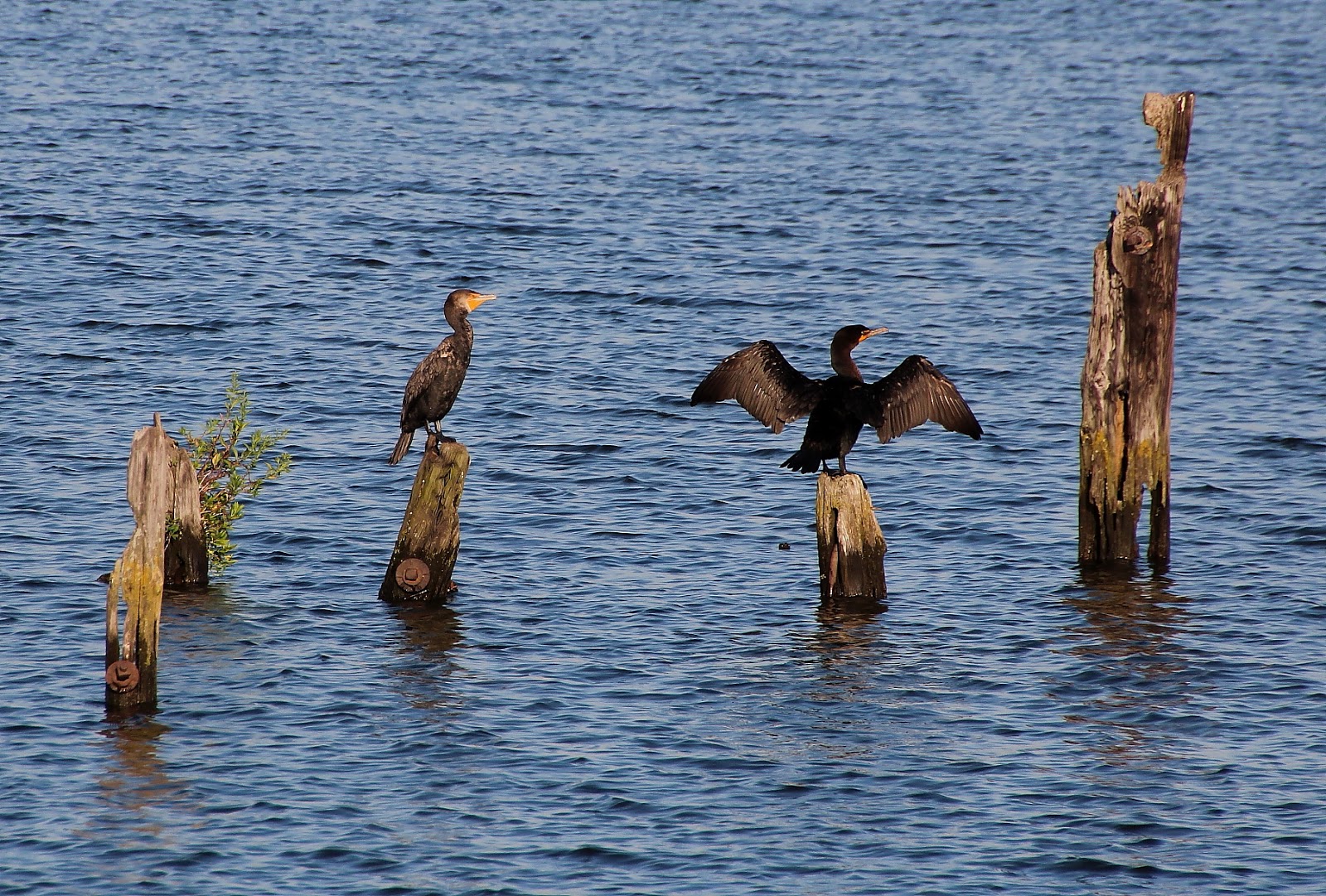
Cormorants on pilings
One of our colleagues who joined us at the pier project said that the site is a very popular gathering spot and is often crowded, even in the winter.  I found that hard to believe because it's really obscure and tucked away.  And, frankly, I don't think it would be all that attractive to the average visitor; the plantings are weedy and the native plants don't provide the show of color found in an annual garden planting.  Perhaps it's the attraction of the "Land Buoy" sculpture/overlook. 
Entrance to pier project
One of the more interesting design features of the site is its landward entrance at the back of a parking lot.  Instead of completely removing the asphalt, the designers cut sinuous channels out of the asphalt down to the soil below, and then they planted native grasses in these channels.  They wanted to simulate and stimulate the natural breakup of asphalt that occurs over time in all unmaintained parking lots.
The sendoff for Michael (second from right; dark shirt)
After our tour of the pier, our group of restorationists went to the Moonshine restaurant in south Philadelphia for a send-off dinner for our colleague, Michael.  The breeze was blowing, the night was pleasantly warm, and the food was really good.  Michael's got a lot more friends and colleagues than those who showed up, but, alas, we were the only ones who could make it. 

Drone over the Preserve

As promised, here's a link to a a 9-minute video of a drone flight over my preserve and an adjacent cathedral.  It was made on Thursday afternoon, September 17. 

https://youtu.be/ksSEqvYb6OA

Friday, September 18, 2015

Invasive Aliens and Alien UFO

A splendid late summer view of my preserve's meadows
A former member of my land stewardship staff, Mike, moved on five years ago to become the land manager at a preserve owned by another land conservancy in our area.  I consider Mike a colleague, and I contacted him when Temple University (where I am an adjunct faculty member) needed an individual to teach a class on invasive organisms.  It was a match made in heaven (both for Mike and Temple), and Mike is now teaching the class for a second year.
Mike (second from right) holding forth on restoration strategies
On Thursday, September 17, Mike brought his students to my preserve to examine invasive plants (no shortage of them here, unfortunately) and our organization's restoration projects.  I spent the morning outside (a rarity for me) accompanying the class as we walked about three miles through the preserve.
Handling (carefully!) an American chestnut burr
One of our stops was a reforestation area planted in 1994.  We incorporated pure American chestnut trees into the reforestation project, and now the trees are 30 feet tall and producing fruits (more appropriately called burrs).  The trees are all infected with the non-native chestnut blight fungus, but they are pumping out burrs like crazy nonetheless.  The burrs are really prickly and painful to hold; I don't know how squirrels manage to get them open.
Preparing for liftoff
After the walk, Mike brought out his drone to show the students how these devices can be useful for examining the landscape from the air.  He flew the drone about one mile away and returned it to the launch site, a tour that took 9 minutes.  The drone has the capacity to fly for about 18 minutes on one battery charge.
UFO spotted over the preserve
Mike remotely piloted the drone to fly over the meadows and woodlands of the preserve, and then to circle the tower on the right (one mile distant) in the image above.  All the while, the drone was sending back remarkably clear video that Mike recorded on his iPad.  He promised to share the video with me; if he does so, I will post it later.