|
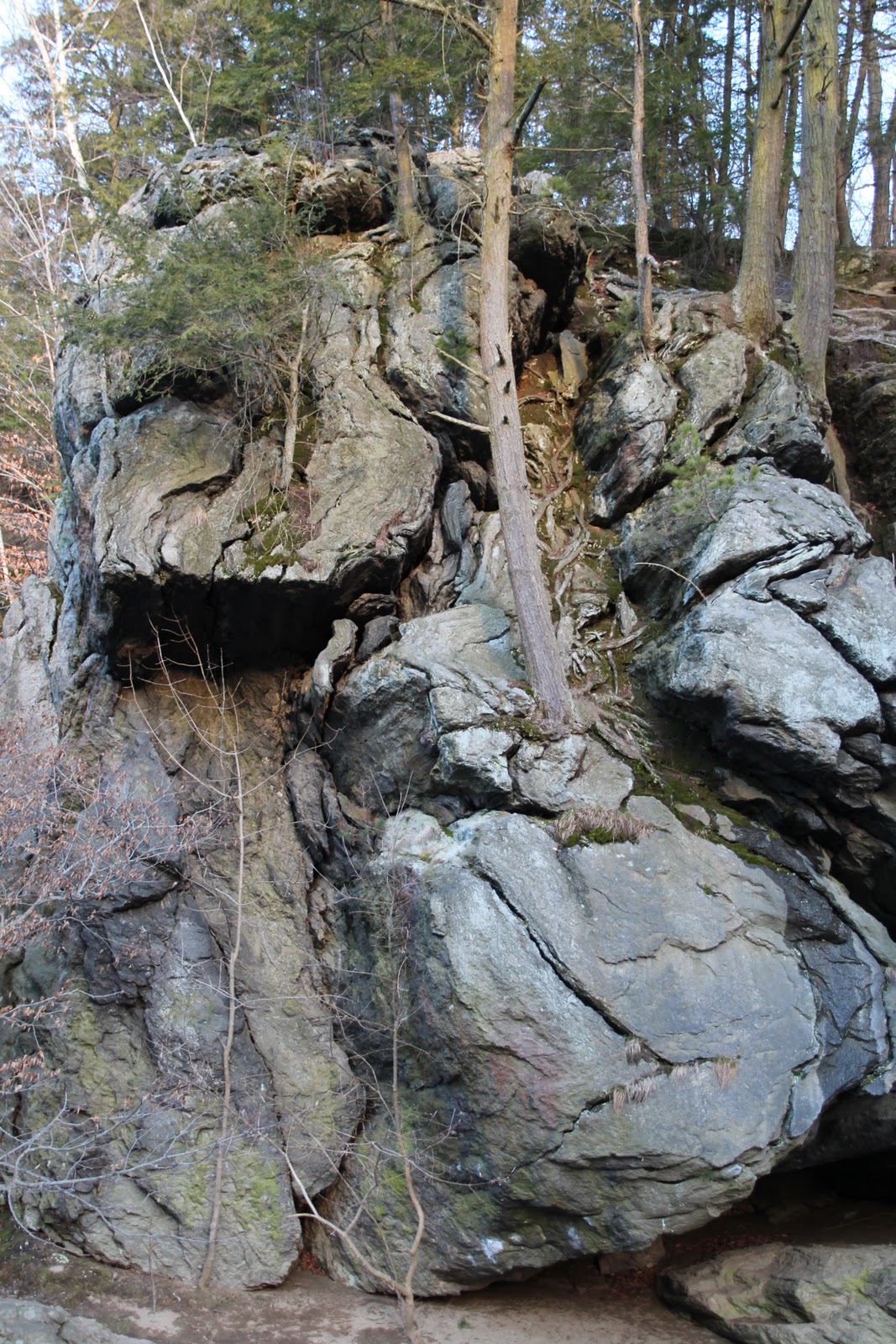
Council Rock in Montgomery County's Lorimer
Park, rising above Pennypack Creek |
For 60% of my life, I lived on sedimentary landscapes. I was raised in northeastern Ohio on the Glaciated Appalachian Plateau. I earned my undergraduate degree at Ohio University on the Unglaciated Appalachian Plateau, then sidled eastward to Pittsburgh, also on the Unglaciated Appalachian Plateau, to earn my graduate degree. From there, I traveled south to Florida, taking up residence for seven years on sand-veneered limestone terrain that has repeatedly bobbed above and below the ocean over the eons.
Kali brought to my attention this morning, out of the blue, that I have now lived in one place for the longest span of time in my life: 22-1/2 years. And, that time has been spent on the Piedmont. I finally have some rock, some real rock, under my feet--not friable shale and slimy mudstone that weathers into clay, or sandstone that turns into grit, or limestone that can drop out from under you without warning. Nope, solid metamorphic schist that's been here for nearly a billion years--some of the oldest rock on the planet. And rock that produces some of the best garden loam on the planet.
Metamorphic rock does have one downside: it doesn't produce wonderful intimate waterfalls, the staircase cascades that defined my childhood. Although the northern Piedmont is full of places with "fall" in their names, most are really just rapids. The only two real waterfalls that I know in the northern Piedmont--falls where water plunges straight down over a vertical cliff--are in Paterson, New Jersey (which has an incredibly impressive state- [if not national-] park-worthy waterfall in the very middle of its gritty post-industrial downtown) and in Ringing Rocks County Park in Bucks County, Pennsylvania. And, even at Ringing Rocks, the falls has developed on an unusual and spatially-delimited metamorphic rock called diabase. Rapids are common; real falls are rare.
 |
| Council Rock, Lorimer Park |
One of the most impressive outcrops of metamorphic schist in my neighborhood occurs in a Montgomery County (Pennsylvania) county park called Lorimer Park. There, rising dozens of feet straight up from the bank of Pennypack Creek, sits Council Rock, so named because the local Leni Lenape Indians reputedly held important meetings near this geological landmark. Today, it's used as a backdrop for wedding photographs and as a place for kids to climb and explore.
 |
| Eastern hemlocks clinging to Council Rock |
It still retains a green mantle of Eastern hemlocks (Tsuga canadensis) despite the foot traffic and the white-tailed deer, which consider hemlocks dessert. But, for me, it's a symbol of the first real firm foundation in my life.
 |
| November's late afternoon sun illuminating Council Rock |