Showing posts with label Natural Lands Trust. Show all posts

Thursday, September 22, 2016

Paunacussing

Kali dispersing common milkweed (Asclepias syriaca) seeds
On Sunday afternoon, September 18, Kali and I joined about 20 other guests at a natural area called the Paunacussing Preserve owned by the Natural Lands Trust (NLT), the largest regional land trust in eastern Pennsylvania.  This guided walk was for long-term NLT supporters and was led by Preserve Manager Preston Wilson supported by another NLT staff member and a volunteer.  Sunday afternoon was very warm, humid, and cloudy with thunderstorms in the forecast, but the very much-needed rain held off until Monday morning.

The 100-acre Paunacussing (named for the creek that rises on the land) contains active agriculture, farmland converted to native meadows, meadows undergoing active afforestation, woodlots, and a large pond.  Topographically, it is fairly level and walking was easy. 

We set off on paths cut through native goldenrod meadows in full bloom.

Old fence post festooned with Virginia creeper (Parthenocissus quinquefolia)
Cooperative azure damselfly perched in the meadow
Thistle gone to seed exposing its silvery underbelly
All afternoon long, the sky was full of vultures.  The light wasn't good, the birds weren't close enough for me to get a good "naked eye" view, and I hadn't brought my binoculars, so I couldn't tell if they were Turkey Vultures (Cathartes aura) (the more likely) or Black Vultures (Coragyps atratus).

Vultures
From the meadows, we moved to the pond on the property.  When the preserve was privately owned and used as both a weekend retreat and as a farm, the owners maintained a fairly sizable pond fed by four springs.  When NLT acquired the property, the land managers decided to reduce the size of the pond and to begin to accelerate its inevitable transition to freshwater marsh.  (Ponds constructed at the headwaters of small streams are ecologically damaging since they create large expanses of water exposed to the sun.  The water discharged from such ponds is much warmer than water in streams should be, altering the entire ecosystem downstream.)
The pond
The land managers excavated through the berm that was damming the creek and lowered the water level considerably.  This exposed large areas of mud that were quickly colonized by emergent aquatic vegetation.  The remaining pond is only about four feet deep.

Beavers have colonized the pond.  Preston explained that he didn't want beavers in the pond because they were cutting down trees and because they were blocking up the outlet channel and the agri-drain system that NLT installed to allow land managers to manipulate the water level.  He said that he had been in contact with the Pennsylvania Game Commission about removing the beavers.  Kali and I do not believe he made a compelling case for removing the beavers.
A beaver's handiwork at the edge of the pond
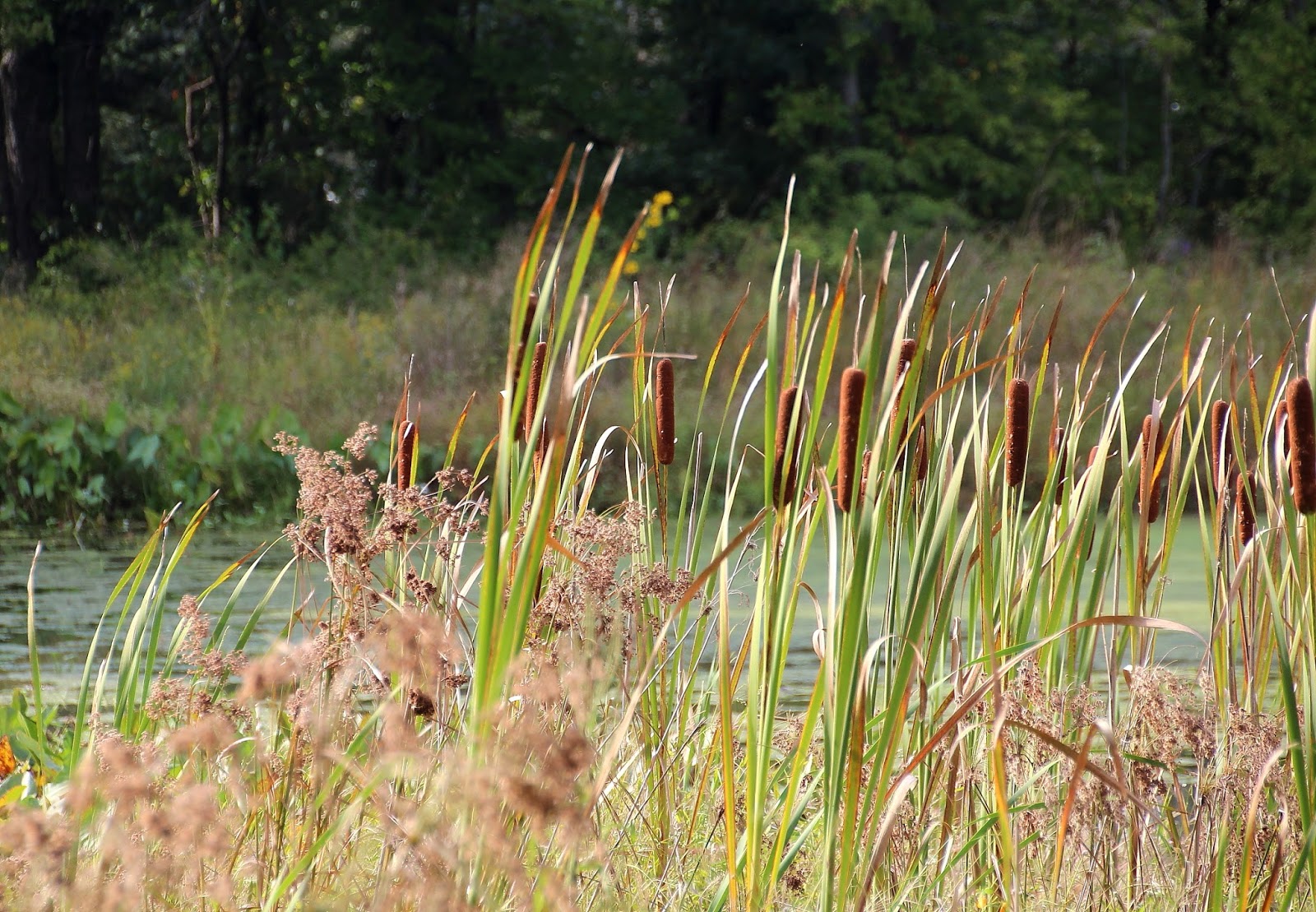
Cattails (Typha spp.)
Cattails and green-headed (or cut-leaf) Coneflowers (Rudbeckia laciniata)
A moss-softened path
From the pond, we ventured into a small woodlot where NLT had erected several fenced exclosures to demonstrate the impact of white-tailed deer.  The enclosures were too new to show much difference in vegetation between areas accessible to and protected from deer browsing.
Preserve manager Preston Wilson (light shirt) explaining the deer exclosure
When we emerged from the woods, I found that I had acquired a new arthropod companion on my lower leg.  I gently coaxed the caterpillar onto a Southern arrow-wood (Viburnum dentatum) leaf.
Note the dense auburn hairs plus the much longer, less-dense lighter hairs
The last part of the tour wound through meadows under active afforestation.  NLT plants tree seedlings in plastic tree shelters.  Over the last few years, they have planted nearly 3,100 trees in the preserve in an effort to join woodlots into large blocks of forest.
Afforestation area with an Eastern Bluebird nesting box
Finally, as we neared the end of the walk, we came across a view of this tree (below) sporting a dozen resting vultures.

Thursday, October 22, 2015

Mariton Wildlife Sanctuary

On Wednesday, October 21, I visited the Mariton Wildlife Sanctuary, one of 42 preserves in eastern Pennsylvania and southern New Jersey protected by the Natural Lands Trust (NLT), a regional land conservancy.  The visit was a special treat for members of NLT's White Oak Society; anyone who has been a NLT member for 10 years or more continuously is automatically enrolled.
Mariton Sanctuary manager Tim Burris (center, with binoculars)
The Mariton Sanctuary is managed by NLT employee Tim Burris.  Tim used to be the head naturalist for my organization, but he moved on one year after I took my job here in 1988.  (Do you think it was something I said...?)  Tim and I have remained friends and colleagues since he left, but I hadn't seen him in quite a few years.  We gave each other big bear hugs when we got reacquainted.
Trail to the Delaware River Overlook
The Mariton Sanctuary is located in extreme southeast Lehigh County, Pennsylvania, right along the Delaware River, about 1.25 hours north of my preserve.  The eastern boundary of the sanctuary drops precipitously to the river road paralleling the Delaware. 
Tim addressing the members of the White Oak Society
"Mariton" is a contraction of the names Mary and Tony, the first names of the couple who owned the property and set it aside for conservation.  Tony and Mary originally bought 38 acres of overgrown agricultural fields and kept adding land as it became available until, by the time they died, they had accumulated 200 acres.  The surrounding countryside is more developed than it was when Tony and Mary owned the land, but now it would be fair to characterize it as exurban - a refuge caught between the sprawl of Philadelphia and the former industrial cities of the Lehigh River valley (i.e., Allentown, Bethlehem, and Easton, Pennsylvania).  
Stone wall in the woods
The sanctuary is perched on the top and eastern flank of a Brougher Hill, a very rocky knob.  Much of the land had been cleared for agriculture, and stone walls constructed of the stones removed from the fields criss-cross the property.
American chestnut leaves
American chestnuts, both naturally occurring as well as some planted by Tony, occur throughout the property.  Tim told us that one technique that early chestnut restorationists tried to prevent chestnuts from dying of the chestnut blight fungus was irradiating chestnuts before planting them, hoping that the zap of radiation would protect the trees.  Of course, the irradiation didn't work (since the fungus is in the soil, not on the chestnuts).  But, some of the irradiated nuts that Tony planted have grown into 25-foot-tall trees that are producing abundant nut crops.

Ann Rhoads, probably Pennsylvania's premier botanist (retired) on right with blue backpack
Tim manages much of the sanctuary in fields and brushy young shrub habitat.  Sassafras trees are abundant in these brushy patches.
Sassafras produce four leaf shapes on the same plant

The day was almost perfect - low humidity, clear blue skies, good fall color.  If I had any complaint, it was that it was a bit too warm; we had temperatures above normal in the mid-70s.

Wednesday, May 29, 2013

A New Preserve to Explore

A sweeping view of hayfields at the ChesLen Preserve
On the Sunday afternoon before Memorial Day (May 26), Kali and I took advantage of the unusually clear, cool day to visit the relatively new 1,300-acre ChesLen Preserve located in central Chester County, Pennsylvania's "horse country."  ChesLen (so named because it is located in CHESter County and was donated by a philanthropist whose surname begins with LEN) encompasses fields, woodlands, wetlands, stream valleys, and a small section of a rare plant community that developed on soils underlain by serpentinite, an unusual rock formed under the ocean and that contains near-toxic levels of chromium and other metals.

We parked in a small lot near the southern end of the preserve and began our 3-mile loop walk by entering fields that gradually transitioned into woodlands.  The woods, relatively young second-growth forest full of the invasive plants that typify all second-growth woods in the northern Piedmont, offered pleasant walking.  While the preserve's excellent trail map only showed one trail threading through the woods, Kali and I found ourselves wandering on what was actually a spiderweb of trails throughout the forest.  We finally descended straight downhill on one of the paths to reach a pleasant, wooded tributary of the West Branch of Brandywine Creek.

Brandywine Creek tributary
Polywogs in a placid channel alongside the main stream
Directly across the stream we happened upon a scenic old fieldstone culvert bearing a trail (probably the remnants of an old farm road) over a rivulet.

Fieldstone culvert
After we crossed the stream, we walked through riparian woodlands for a short distance, then ascended the other side of the stream valley through expansive, open grasslands.  With clear, blue skies, a cool breeze, and expansive views, it was glorious; we felt like breaking into a song from the Sound of Music.

Kali ascending the hill through grasslands
Prior to becoming a preserve owned by the regional Natural Lands Trust (NLT) conservancy, ChesLen had been a private working farm.  To maintain the fields and prevent invasion by the non-native pasture-snatchers (e.g., multiflora rose, autumn olive, honeysuckle), NLT plans to continue to manage the fields through agricultural leases for the foreseeable future.

Because CheLen will become one of the NLT's signature preserves (both for its size and the diversity of habitats it protects), the conservancy recently completed a new visitor contact/public events/land stewardship center on a knoll overlooking the fields.  It's a classy facility reflective of the importance of the preserve.  The new facility will be dedicated in June.

New visitor contact/public events/stewardship center
A bit "raw," but impressive nonetheless
After a close-up visit to the new facility, Kali and I continued our walk through more meadows full of buttercups (Ranunculus spp.)

Buttercups along the trail
Fleabane (Erigeron spp.) hosting two native bees
The trail finally turned away from the fields and entered the valley created by the rivulet we saw flowing under the fieldstone bridge earlier in our walk.  We quickly found ourselves back at the stream we had crossed earlier.  We crossed the stream and re-entered the woods where we had lost our way at the beginning of the hike, finally finding the elusive trail junction where we should have turned.

May-apple (Podophyllum peltatum) with fruit on the streambank
Kali picking her way across the stream on natural stepping stones
ChesLen is a nice place, even if the vast majority of it is still devoted to active agriculture.  Our walk only covered a very small part of the trail system and there's plenty of interesting habitat to explore.  I just wish it weren't such a long drive (1.25 hours) from home.