Showing posts with label volunteering. Show all posts

Monday, November 10, 2014

Class Field Trip


High School Park Restoration Manager Kevin (bearded, far left) with students
On Friday, November 7, I accompanied my Ecological Restoration students from the University of Pennsylvania on a field trip to High School Park in one of Philadelphia's "inner ring" suburbs.  I've written about High School Park in several earlier posts.  The park is the site of the municipality's original high school, which was abandoned when a new school was built in another location, fell into decrepitude, and was finally razed.  Since then, the 11-acre park has been adopted by a "Friends" group, which has been working to restore the riparian woodlands, up-slope forests, and hilltop plateau with native plants.
Stairs leading from former athletic fields to the hilltop location of the old school
Our guide for the trip was the Friends' Restoration Manager, Kevin.  Although the site is small, it is overrun with invasive plants.  Because the park is public property, Kevin is not authorized to use herbicides.  In addition, he has no help other than volunteers that he can cajole into working.  In my opinion (and experience), he's fighting a losing battle, but he is supremely dedicated to the work and to the Friends.
Along a mid-slope forest trail
Because the park is located in an "inner ring" suburb, its infrastructure is old.  The sewer line following the creek that runs along the north edge of the park is leaking, and the municipality must replace it.  Next spring, the municipality's contractor is going to excavate a massive trench alongside the creek and through a major portion of the park to install a new 5-foot concrete sewer pipe.  Any work that Kevin has accomplished to date there will be destroyed.  I'd find such a setback really disheartening, but Kevin sees the silver lining in these storm clouds because the construction will require streambank restoration and he thinks the park could actually end up better than it is now.

I'll withhold judgement until I get a chance to see the work.

Thursday, August 14, 2014

StreamWatch

The creek in the county park downstream of my preserve
Our land trust is partnering with the watershed association that champions the environmental quality of the stream that drains the land to our southwest.  Last evening, our two organizations convened a joint training session for prospective stream monitoring volunteers at the county park downstream of my preserve.
Classroom training
About 20 people showed up for the training, which began with a PowerPoint introduction to the monitoring protocol.
Choosing a monitoring site
Then the volunteers split up between the two watersheds to choose their monitoring sites.
Creekside fieldwork.  The prominent outcrop in the background is called Council Rock.
Finally, we moved to the bank of the creek to apply the concepts introduced in the PowerPoint presentation to the "real world."  By then, the sun had started to set.

The volunteers were asked to pledge to monitor their section of the creek once a month - a two-hour commitment.  Everyone who attended was enthusiastic and seemed willing to commit more than two hours each month.
A riffle at sunset

Sunday, August 25, 2013

Share Duty


Weather-vane atop Pennypack Farm Harvest House
Kali and I are shareholders at an organic Community Supported Agriculture farm called Pennypack Farm.  One of shareholders' obligations is to contribute volunteer labor to the farm each year; the farm calls it share duty.

With temperatures in the mid-70s, low humidity, and clear skies, we decided that Saturday (August 24) would be a perfect opportunity to fulfill our obligation for the year.

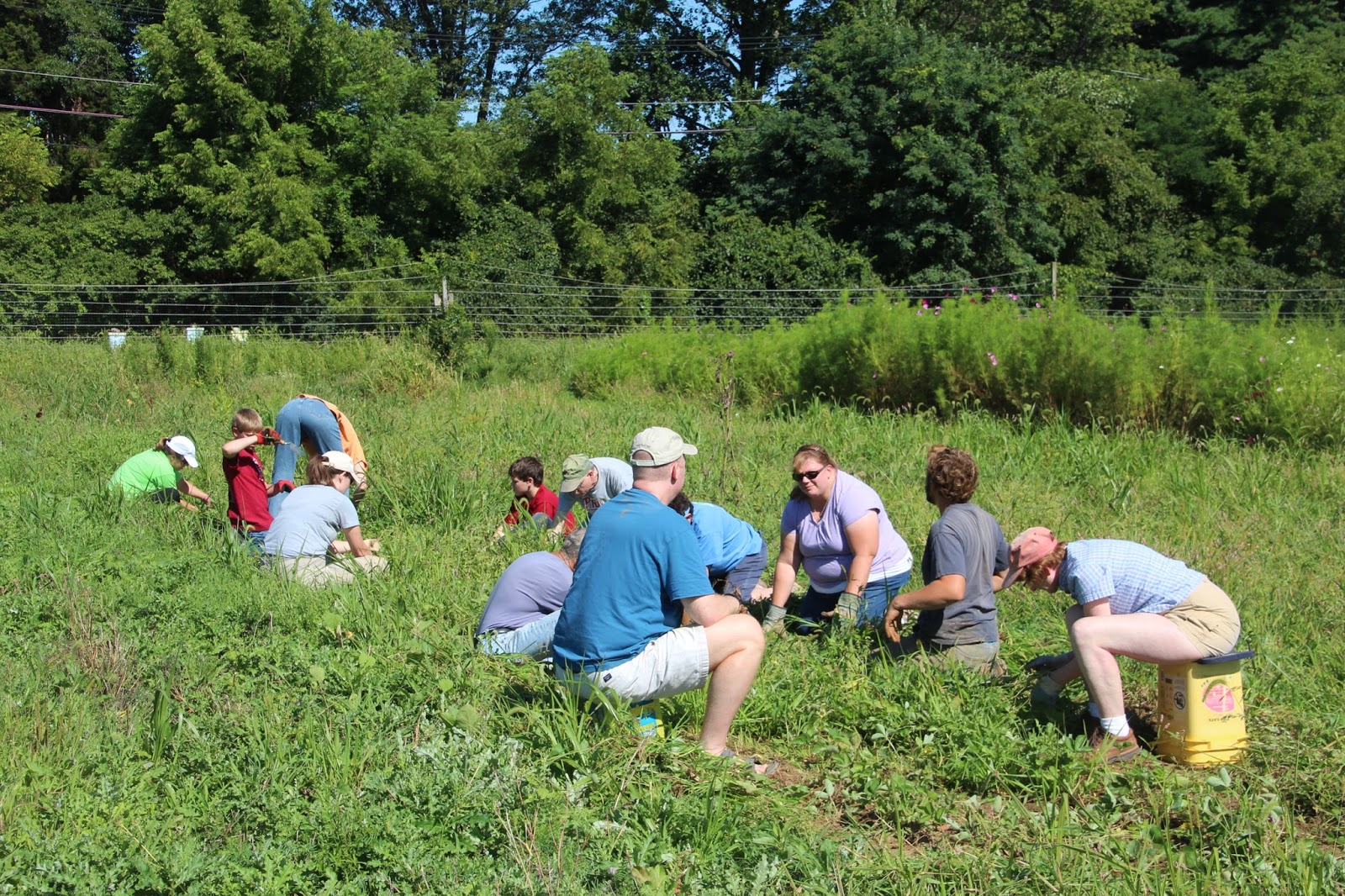
When we arrived, the farmer asked us to join a group weeding the completely (hopelessly?) overgrown strawberry beds.  Weeds and grasses had grown up so intimately with the strawberry plants that uprooting the weeds often uprooted the strawberries as well, but we did the best we could.
Weeding strawberries; Kali seated on bucket
Kids helped out, mostly by filling the wheelbarrow with uprooted weeds
Then, suddenly, mid-row, Farmer Devin announced, "Let's weed the brassica beds!"  I don't know if he was bored or just realized that the cabbages and broccoli would be coming on sooner than the strawberries, but we dutifully migrated en mass to the rows of cole vegetables - which were much easier to weed.

Weeding cabbages and broccoli
A ladder set aside struck Kali's fancy
When we'd finished helping out, Kali and I treated ourselves to cups of sea salt caramel pretzel flavored frozen yogurt topped with crushed Heath bars and chocolate chips.  It was a good day.

Monday, April 15, 2013

Creek Cleanup


Trash collected by Viridian Energy volunteers
We held our annual creek cleanup along "my" creek and several tributary streams last Saturday.  Despite showers on Friday, the streams were not particularly high on Saturday, and the day was sunny and temperatures were perfect - in the low 60s.

With over 100 individuals from Scouts, church groups, and companies volunteering at this event, we needed to spread the workforce over the landscape.  I took a group to a nearby municipal park where a tributary draining the main commercial hub for the region originates.  Because of the commercial activity in this stream's headwaters, we can always count on collecting plenty of trash on the floodplain.

Round Meadow Run, the tributary where I worked,  near its mouth
I had volunteers from Viridian Energy, an electric utility supplier in the region, and from Planet Aid, a non-profit organization that re-purposes and distributes donated clothing and housewares.

Viridian Energy volunteers
Because we have not had a major flood since August 2011 when Hurricane Irene and Tropical Storm Lee roared through the valley (2012's Hurricane Sandy caused tremendous wind damage, but did not produce much rain), there was not an inordinate amount of trash to collect.  Floods wash debris out of the watershed and deposit it on the floodplain, but this year we mostly collected routine stuff, especially plastic bottles and Styrofoam.

Round Meadow Run (foreground) joining "my" creek (right)
"My" creek is too large to ford easily, so volunteers from Planet Aid used a downed tree
The volunteers from Planet Aid discovered a dead beaver in the creek just upstream of the downed tree they used to gain access to the opposite shore.

Heading back for lunch
The three Planet Aid volunteers; it's not apparent in the image, but Dave (center) had fallen in the creek
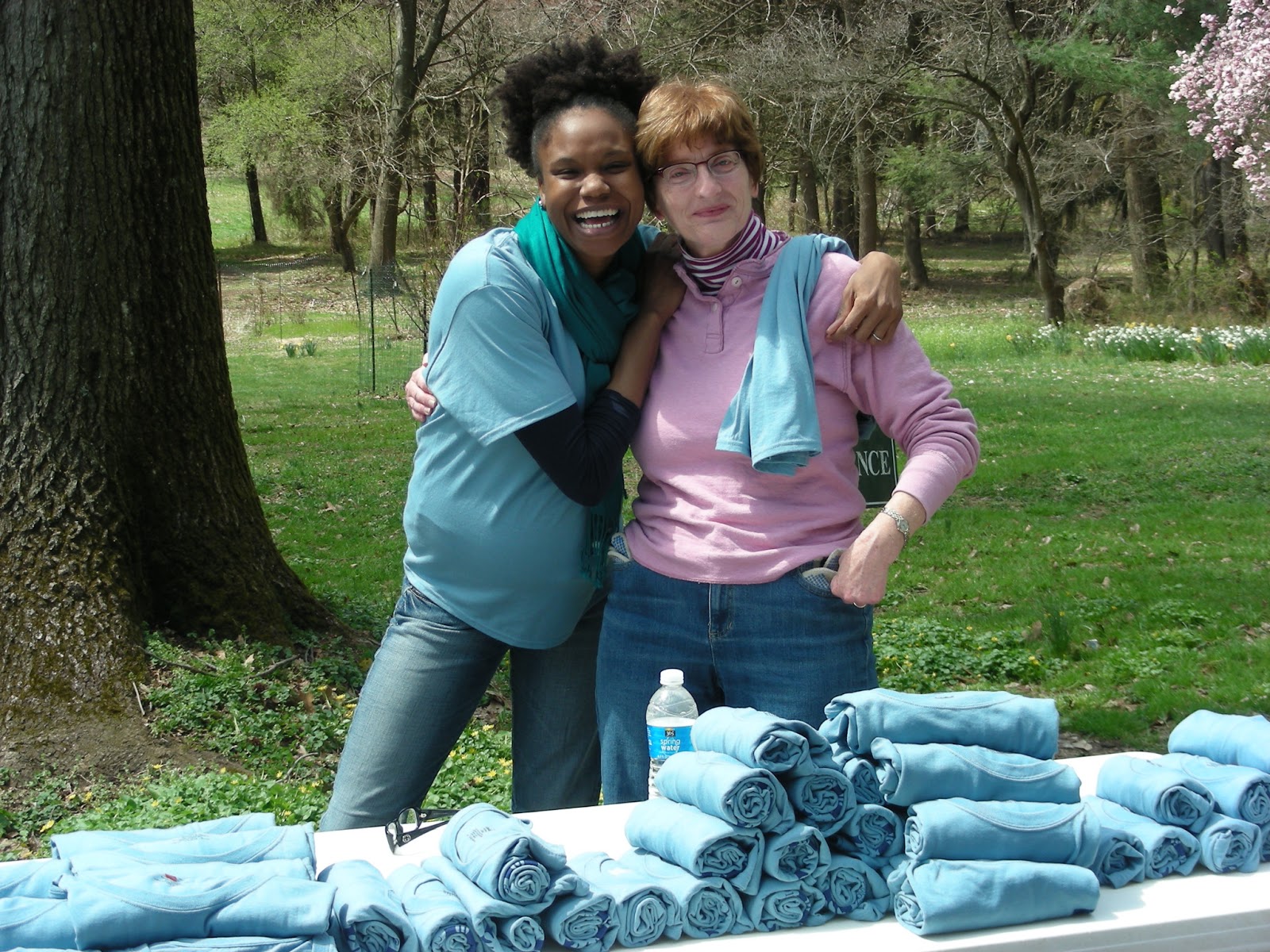
Very pregnant Lavonne (left), our marketing guru, and Kali distributed t-shirts
Back at the Visitor Center, we treated the volunteers to lunch provided by Whole Foods, and we gave each volunteer a commemorative t-shirt.

Lunch in the picnic area
The creek cleanup, our biggest event of the year, is hectic and chaotic, but it's also our biggest "friend raiser."  We don't get that much trash out of the creek, but the event gets people familiar with us, and it makes the participants feel good about being able to do something to help the environment.

Friday, July 3, 2009

Farmworker (for half a day)

Volunteers preparing harvested vegetables for distribution at the CSA

We spent this morning at the organic Community Supported Agriculture (CSA) farm to which we belong. It was a perfect day to put in our required minimum four hours of volunteer labor for the year--mostly cloudy and in the low 70s.


The farmer gave us our assignment when we arrived: he asked us to clear mile-a-minute vines (Polygonum perfoliatum) off a pile of highly composed leaf mulch that the farm uses for fertilizer and soil conditioner. Mile-a-minute, for those of you who don't know it, is a highly invasive nonnative vine that grows like crazy during the summer (hence its name). It was introduced from Asia in the 1940s, hitchhiking on the root ball of imported rhododendrons. Since then, it has spread insidiously throughout the East Coast. It's got tiny little recurved (i.e., facing backward) barbs along its stem that make the use of gloves mandatory.

The compost pile was also covered with Canada thistle (another nasty plant imported from overseas--not from our neighbor to the North, as its common name would suggest). So, we spent the next two hours hand-pulling the mile-a-minute and the thistle until the pile was cleared off, we were tired and drenched in sweat, and our legs and arms were itching with contact dermatitis.

After our work was completed, we had an opportunity to pick-up our food share for the week: kale, green beans, kohlrabi, Swiss chard, lettuce, and cucumbers.